


By Nadine Nirere
Five days, two districts, one country, countless stories.
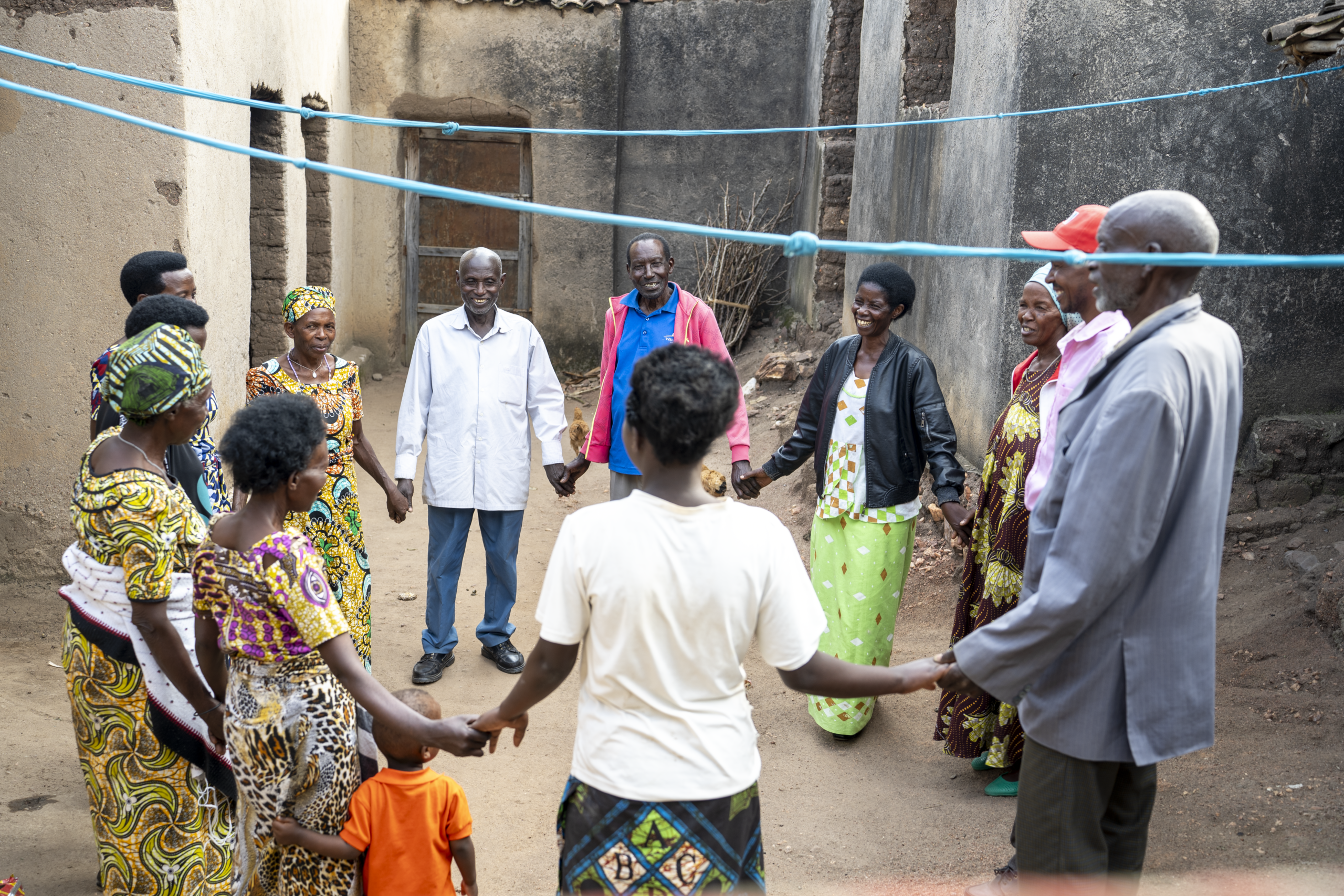
I recently travelled through Rubavu and Rutsiro districts in western Rwanda to attend graduation ceremonies marking the completion of the fifteen-session sociotherapy cycle and to collect participant stories for an upcoming documentary. Each conversation reminded me that personal stories remain one of the most powerful ways to understand sociotherapy’s impact on individual community healing.
I met young women whose lives had been deeply affected by adolescent pregnancy. I sat with families who once lived in constant conflict but now spoke about peace in their homes. I listened to genocide survivors who had found the courage to sit in the same circle as former prisoners who had participated in the 1994 Genocide against the Tutsi. Men and women shared how they overcame alcohol addiction, rebuilt relationships with their children and partners, and started restoring their livelihoods.
Each story was different, each person carried unique wounds, different regrets and hopes. Yet as the week went by, I found myself returning to one question:
What actually happens inside a sociotherapy group that makes this kind of transformation possible?
At first, I expected there might be a simple answer. Perhaps the group facilitators said something that helped people heal. But after listening to testimony after testimony, I realised that transformation rarely happens in a single moment. It is a process that is different for every participant.
In Rubavu, I met groups of young women who had experienced adolescent pregnancies. Before joining sociotherapy (in Rwanda known as Mvura Nkuvure), many described lives shaped by shame, rejection, sorrow, and isolation. Some had withdrawn completely from their communities because they could no longer bear the judgement they encountered every day. Others had been rejected by their families or abandoned by the men responsible for their pregnancies. Many spoke about carrying a deep sense of worthlessness.
“There was a time when I couldn't even leave my home because of shame and embarrassment. But through Mvura Nkuvure, I found freedom. Today, I am looking for ways to improve my life, take care of myself, and provide a better future for my child.” -Female participant, Rubavu district.
“I never wanted to be where other people were. I had been rejected by my own family. I held resentment toward everyone and had bitterness in my heart. But through meeting others in the group, hope gradually began to grow within us, and we came out of isolation.” -Female participant, Rubavu district.
Today, these same women speak differently about their situations. They talk about rebuilding confidence, caring for themselves again, and finding ways to create better futures for their children. They describe leaving isolation behind and rediscovering hope. Rather than allowing their circumstances to define them, they have begun making new decisions about their lives, seeking opportunities to earn an income, support their families, and restore the dignity they believed they had lost.
One participant shared: "Because of Mvura Nkuvure, we found freedom. Now we want to work, improve our lives, care for ourselves, and our children." -Female graduate, Rubavu district.
In Rutsiro, I encountered different stories but similar transformations.
Many participants described homes once dominated by arguments, mistrust, and conflict. They reflected that peace begins at home because the safety experienced within a family naturally extends into the wider community.
After being released from prison, I returned home to discover that my wife had learned to manage the household independently during my absence. Instead of working together, we found ourselves locked in constant disagreements over money and decision-making. I interpreted her independence as disrespect; she experienced my behaviour as controlling. Every conversation became another argument. During Mvura Nkuvure sessions, I began reflecting on humility, communication, and mutual respect. Gradually, I learned to approach conversations calmly instead of defensively. My wife also began responding differently. Today, every financial decision is made together. Our home has become a place of discussion rather than conflict. -Male participant, Rutsiro district
Another participant shared openly about decades of alcohol addiction.
“I started drinking alcohol when I was sixteen years old. I became addicted and spent most of my time in bars. I neglected myself, had no progress in my life, and couldn't achieve anything. My eldest daughter eventually left home because alcohol had taken control of my life.
During one of our group discussions on trust, I began reflecting on myself. I realized that my daughter had lost trust in me and had chosen to leave home. I also realized that no one in my community trusted me anymore. That was the moment I understood that I needed to change.
Before joining Mvura Nkuvure, I couldn't maintain my home, pay my children's school fees, buy clothes for myself, or even provide food for my family. I spent more time in bars than I did at home.
Another session that deeply impacted me was the discussion on respect. I came to understand that no one could truly respect me if I didn't first respect myself. That realization led me to make a firm decision to change my life.
Today, I have completely stopped drinking alcohol. I now have four chickens and eighteen rabbits. I can provide food for my children, care for them, and take care of myself. My children are in school, their school fees are paid, and there is food on the table.” -Female participant, Rutsiro district
Perhaps the most profound story I heard that week came from Ayinkamiye Antoinette (name changed), a sociotherapy facilitator and survivor of the 1994 Genocide against the Tutsi.
Antoinette first facilitated a group of genocide survivors because their pain reflected her own experience. As the sessions came to an end, participants expressed an unexpected wish: they felt it would have been better if the group had included both genocide survivors and former prisoners who had participated in the genocide, creating space to hear the truth and offer forgiveness.
Their request eventually led Antoinette to compose such a group and facilitate it herself. As the group progressed, the former prisoners encouraged her to reach out to others in the community, including those who had remained distant from the community. Among them was a man responsible for murdering members of Antoinette’s own family. She admitted she was terrified.
When she first approached him, both trembled. Even shaking hands felt impossible. Yet he agreed to join the group. As the sessions went by, something remarkable happened. During one discussion, the man quietly confessed, “I have nothing to say because the blood of those I killed condemns me.” The room fell silent, Antoinette looked at him and simply replied, “Be strong.”
Later, during a session on trust, he asked her a question she never expected to hear: “I don't understand how you could bring me into the light when I destroyed your life.” In that moment, something shifted for both of them; “I realised that he was no longer a monster to me, but a human being with emotions.” Antoinette reflected.
Their healing journeys were different, but they happened within the same group.
After hearing so many testimonies, I realised there is no single formula for healing. Participants describe transformation differently. For some there were listened to without judgement; for others, a group member shared a story that sounded like their own; for those living in isolation, someone welcomed them into a space where they no longer had to pretend.
Sometimes healing began before the first session even started, when a facilitator knocked on someone's door and invited them into the group. That simple invitation reminds them they still belong.
After the field visit, Mvura Nkuvure, meaning “Heal me, I heal you,” carries even greater meaning for me. Healing is not something one person gives to another; it is something people create together. And that, to me, is the power of Community-Based Sociotherapy.
The group becomes the place where dignity is restored, trust is rebuilt, and new life begins, not because everyone shares the same story, but because no one has to carry their story alone.