


Community-Based Sociotherapy
What is CBS
Destructive actions experienced during war, genocide, and other forms of collective violence result in dehumanisation, a feeling of which can be described as a loss of social dignity. Social dignity is akin to ubuntu as conceived in Southern African philosophy, referring to the relational aspect of being human. When people destroy, harm or hinder the life of others, they not only reduce the humanity of those others, but diminish their own humanity in the process. The restoration of social dignity is therefore essential to resolving conflict and averting future violence.
Community-Based Sociotherapy helps people transforming social relationships, individual beliefs and attitudes, rebuilding trust, processing traumatic memories and restoring social dignity to shape a better future. Through this process it helps people to live their lives in peace, and re-establish meaningful relationships in their communities.
Increase of social dignity leads to other changes such as improved mental health and psychosocial wellbeing, increased interpersonal reconciliation, social cohesion, civic participation, improved family dynamics and gender equality, reduction of gender-based violence, mitigation of intergenerational legacies of mass violence and higher levels of conflict resolution.
The history of CBS
With its roots in post-WWII Europe, the clinical sociotherapy approach was transformed into a community-based approach in Rwanda in the aftermath of the genocide, in response to widespread relational and collective trauma. At the time, the country faced a severe shortage of professionals to provide psychosocial support at scale, calling for a community-based model.
In 2005, community-based sociotherapy was developed through a collaboration between Bishop Emmanuel Ngendahayo of the Anglican Church in Byumba, Dutch sociotherapist Dr. Cora Dekker, and medical anthropologist Prof. Annemiek Richters. The model draws on the therapeutic community approach used in UK military hospitals after World War II and later adapted in the Netherlands in the 1970s for psychiatric care, including support for traumatised refugees from conflict-affected countries.
Refugees who benefited from sociotherapy emphasized that such support could have helped their home communities prevent conflicts from escalating into violence. Building on this insight, partners in Rwanda adapted the Dutch model into a community-based approach to address post-genocide trauma at scale, integrating local knowledge and training community members to facilitate group sessions.
It has since been adopted across regions in communities where violence of the conflict destroyed social dignity and social conectedness.
Integrating
peacebuilding
mental health
psychosocial support
Peacebuilding involves addressing the psychological, relational, and structural dimensions of complex societal challenges to support the transformation and strengthening of societies.
Community-Based Sociotherapy (CBS) specifically addresses the relational dimension, which is closely intertwined with the psychological aspects of recovery. By fostering socio-emotional healing, rebuilding trust, and improving interpersonal relationships, CBS supports reconciliation at the community level and contributes to peacebuilding from the ground up.
In this relational context, the CBS group functions as a therapeutic space through which participants collectively work toward restoring social dignity.
Community-based and trauma-informed method
CBS operates in geographically defined places, such as a neighbourhood, a school, a church, a prison or a refugee camp, where people live together and share similar life conditions, but a sense of a shared social world may be absent. The healing process commences during the group sessions but continues during encounters outside the group as participants live close to each other. CBS facilitators are members of the same community.
Another aspect of the community-based character of CBS is that the topics of discussion emerge from what preoccupies people living in close proximity in a ‘bottom-up’ experiential way, rather than in a ‘top down’ cognitive or instructive manner. When, for example, the topic of ‘safety’ is on the agenda, the conversation is facilitated by the sociotherapy facilitators towards people sharing what makes them feel safe or not safe and how this affects them. In the process they co-construct a locally-informed, and thereby ‘community-based’ consensus on what constitutes safety.
CBS is a trauma-informed approach that focuses on psychosocial functioning rather than mental health or psychological disorders. Working in a trauma-informed way means having an ongoing awareness that the long-term reaction to trauma may limit one’s abilities to cope with life’s tasks and challenges. In CBS people are not asked to disclose their traumatic experiences. The focus of CBS is daily life challenges. Speaking or thinking about these challenges may, however, touch upon traumatic memories which in turn may trigger trauma response. When this happens, the CBS group provides safety through containment and support.
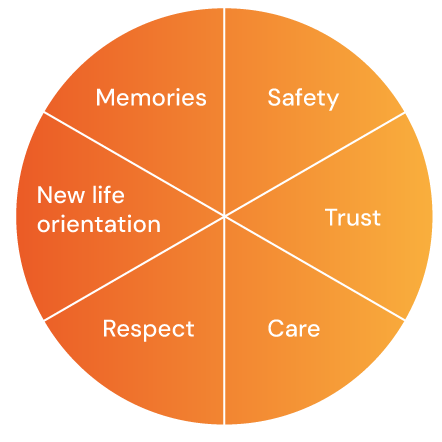
CBS phases
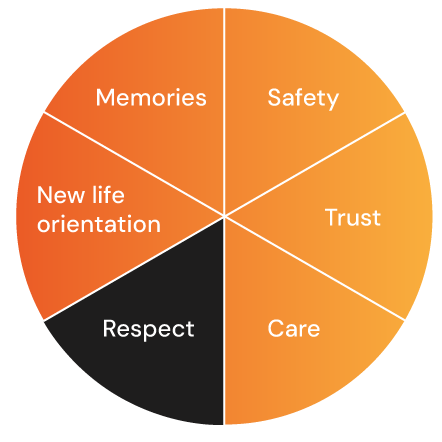
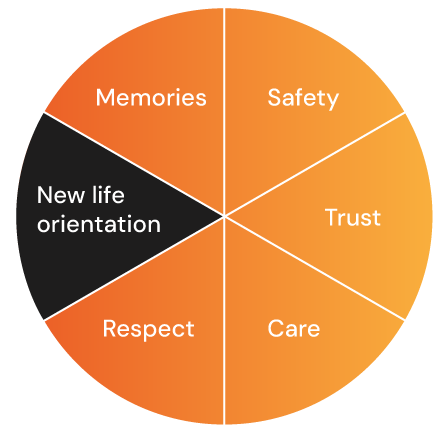
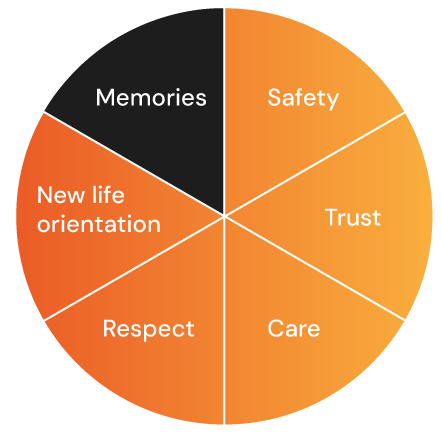
Sociotherapy is conducted in groups of ten to fifteen participants and facilitated by trained community members. Meeting weekly for three hours over a fifteen-week period, the groups convene in safe, familiar settings such as schools, churches, private homes, or outdoor spaces. Two facilitators guide participants through six phases—safety, trust, care, respect, new life orientations, and memories of emotions. The process is grounded in seven core principles: interest, equality, democracy, participation, responsibility, learning by doing, and focusing on the here and now.
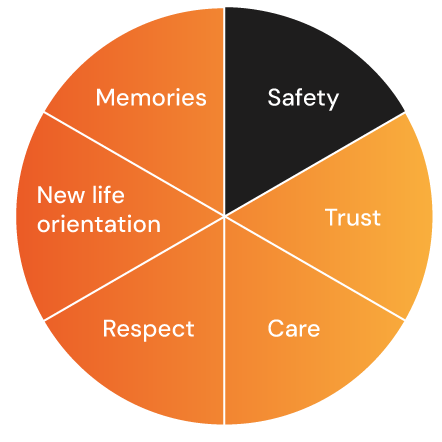
Safety
Safety is foundational to healthy relationships, and its absence places all interpersonal dynamics under strain. It encompasses two dimensions: physical safety—freedom from the threat of bodily harm—and psychological safety—freedom from humiliation or emotional harm. Because many participants in war-affected contexts report profound feelings of insecurity, facilitators must prioritize establishing safety from the outset. They do so by creating clear structure, incorporating supportive social activities, and engaging participants in discussions about what safety means to them and within their broader social environment.
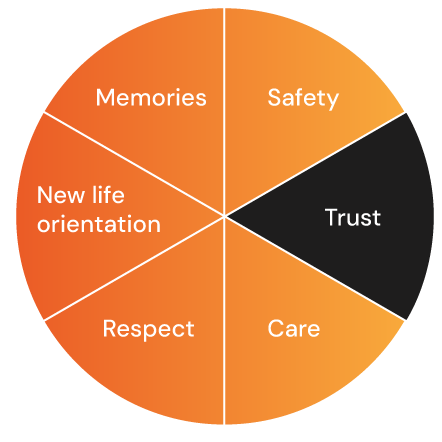
Trust
Trust arises when individuals feel that others recognize and value their capacity to contribute to group or community decisions. It is built on integrity and a sense of hope, and begins to emerge naturally once a foundation of safety has been established in the sociotherapy group. The goal of this second phase is to help participants regain the ability to trust—an essential step for those who have experienced trauma and a critical precondition for creating a supportive and healing group environment.
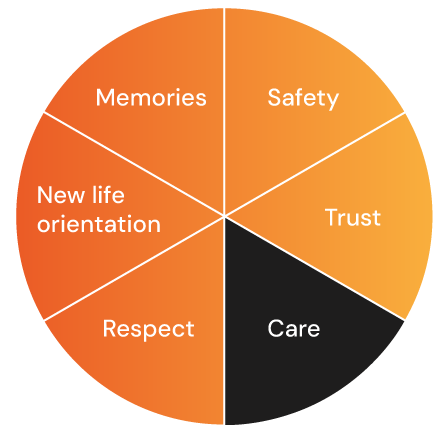
Care
Care is conveyed through acknowledgment—giving others full attention by listening, validating, and responding to their concerns, feelings, and experiences—as well as through inclusion, which involves ensuring that people feel they belong, whether in a family, community, organization, or nation. This phase focuses on supporting individuals who, due to difficult experiences, may struggle to care for themselves or others. Hardships are expressed in diverse ways, and the process encourages participants to reflect on these experiences and to cultivate caring behaviors, both toward one another and through practices of self-care.
Respect
Respect involves recognizing and validating others, treating them with compassion, and showing appreciation for their contributions and ideas. As participants gain a stronger sense of safety, trust, and care, they become more able to express tensions that may stem from cultural differences in the understanding and practice of respect. Facilitators help the group explore these differences by introducing the topic in a structured and supportive way, encouraging participants to articulate the forms of respect they value and how these relate to their present-day realities
New life orientation
New life orientation focuses on taking responsibility for one’s actions, committing to change harmful behaviors, and engaging in practices that uphold one’s own dignity as well as that of others. In this fifth phase, the group turns toward future-oriented discussions. Participants often express a desire to influence the rules and institutions that shape their communal lives. By highlighting how rules can vary—even in simple activities such as games—facilitators help participants reflect on constructive ways to exercise agency and engage in decision-making that affects their futures.
Memories
Memory refers to how an individual’s sense of self is shaped by the recollection of both positive and painful life experiences. A key element in this phase is the realization that one is not alone, which is essential for restoring social dignity. Bearing witness to the pain of others often evokes one’s own suffering, fostering compassion and the recognition of shared human experience. By the final phase, participants have developed trust in the reliability of the sociotherapy group, creating a supportive environment to explore deeper processing of traumatic emotions. Through reflecting on both positive and difficult memories, participants gain new perspectives on their past and can make informed decisions about whether additional support from a specialist is needed.
CBS principles
As groups progress through the six phases, the sociotherapy principles are consistently applied at every stage. These principles serve as essential guiding frameworks, shaping the structure, interactions, and overall process of the sociotherapy groups.
Equality
Participants in the sociotherapy groups are treated as equals. Despite any formal or informal roles or status in daily life, the members in the group will be treated as equals, including the sociotherapy facilitators.
Democracy
Democracy in the context of sociotherapy means participation in open communication. Group decisions are reached in a transparent way and as a rule become the decision of the group.
Participation
Participation means involvement, joining in and taking part. Participation refers to verbal and non-verbal communication and may have an active or passive character and is a condition for the democratic principle.
Responsibility
In the context of sociotherapy, participants are taking responsibility for participation in open communication with the aim of creating a pleasant group atmosphere and solving problems together. This is another condition for the democratic principle.
Here and now
This principle refers to the focus of discussions in the group and their sphere of influence. Facilitators encourage participants to focus on what is happening in their daily life or in the current moment in the group. The sphere of influence is the “here-and-now”. When past and present experiences have an effect on a participant’s current wellbeing, the group can explore together ways to support one another and learn from and with each other.
Learning by doing
Through this principle, participants learn experientially within the sociotherapy group how recurring challenges in their social environments can be better understood, approached in new ways, and, when possible, mitigated.
Inter-est
Inter-est is described as “something that lies between people and therefore can relate and bind them together”. In community-based sociotherapy this means to determine how the space between people is used and what attitude is adopted with respect to the other.